Leaders Community · IFM Global
In 2027, the difference will lie in what cannot be bought.
In 2026, artificial intelligence became something any company can buy. Judgment, talent and trust cannot be bought: they take years to form, and that is where 2027 is decided. "The State of Human Leadership 2027", the annual study by IFM Global, shows it in twelve findings, each with a figure and a source and each with a question for your decision-making table. You receive it when you join the Leaders Community, together with the course "The Six Questions". The English Weekly Strategic Edition is in preparation, and it reaches this list first.
By joining you go on the English list of the Leaders Community, which is kept separate from the Spanish one. You will receive the Weekly Strategic Edition in English as it is published, and we open your account in IFM Global Online, our business intelligence platform, where the study is read and downloaded and the course is taken. You can unsubscribe from the edition whenever you like. Prefer Spanish? Join the Spanish community.
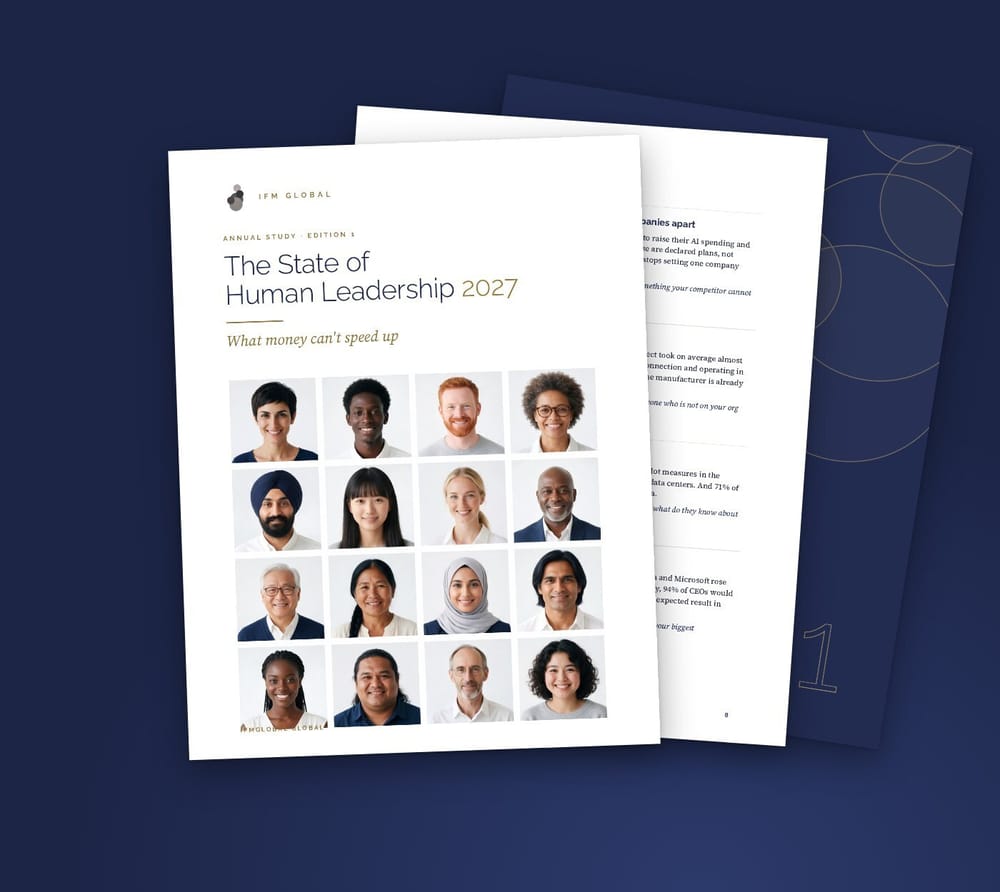
The name of the study
Why we say human leadership
Until recently, saying "human leadership" sounded redundant. Today it does not. AI agents work inside teams, carrying out tasks with their own credentials and metrics, and the first humanoid robots are arriving at plants and warehouses.
When part of the work is done by something that is not a person, what is asked of whoever leads changes, and a new question appears: where is the place of the human in that organization.
The study answers from what money can't speed up (judgment, credibility and the talent that is formed over years) and invites you to evolve your leadership for the world to come.
Why now
Some changes do not come twice in a single career.
In the first half of 2026, Alphabet, Amazon, Meta and Microsoft invested USD 294.8 billion in infrastructure, 84% more than a year earlier (IFM calculation based on their SEC filings). In that same year, 56% of 4,454 chief executives in 95 countries said artificial intelligence had not yet given them either more revenue or lower costs (PwC, January 2026).
Together, the two figures say something neither says alone: the money has already moved and the result still has no owner. Our reading is that when this happens, the advantage does not go to whoever spends the most. It goes to whoever arrives prepared.
At IFM we believe that whoever leads today will hardly see another change of this scale in the rest of their career. That is why it matters less which tool you buy this year and more what you are forming in the meantime: your judgment, your team and the trust of the people around you. None of that is bought ready-made. It accumulates, and it takes time.
For that preparation we put together three pieces. Together they make up the Leaders Community.
How the three pieces work together
Piece 1 · The study
Shows you the world
142 pages, 40 charts and twelve findings, each with a figure, a source and a question for your table.
Piece 2 · The course
Shows you yourself
Six questions that test your judgment and leave you a written map of how you decide.
Piece 3 · The weekly edition
Keeps the pulse
Every week, from sourced facts, what moved in the system and what it means for you.
Piece 1 · The study
The State of Human Leadership 2027. What money can't speed up.
A 142-page study with 40 charts. It is not a survey of our own or a news digest. It integrates what institutions, universities, companies and consultancies published, with academic studies, authors ranging from Sun Tzu and Clausewitz to Donella Meadows, and the news of 2026. Everything is joined in one systemic reading of the world we live in, with an analysis of what connects with what and what it means for whoever decides. Signed by Ibo F. Meléndez and Sebastián Meléndez.
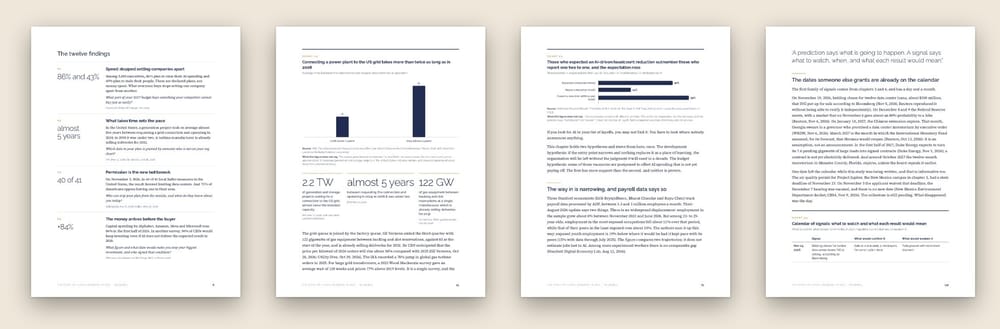
Inside you will find:
- Why 86% of 3,650 executives plan to raise their spending on artificial intelligence and only 43% plan to train their people, and what stops distinguishing a company when everyone buys the same thing (Accenture, December 2025).
- What sets the date of a plan today: in the United States, a power generation project took on average almost five years between requesting the grid connection and operating in 2024; in 2008 it was under two (RMI, March 2026).
- The vacancy that does not open: employment among 22- to 25-year-olds in the occupations most exposed to AI is 19% below the pace of their less exposed peers (Stanford Digital Economy Lab, August 2026). And what that means for your 2035 succession list.
- The layer that carries the change is the one most worn down: global manager engagement fell from 27% in 2024 to 22% in 2025 (Gallup, State of the Global Workplace 2026).
- Why the top sees a different company: 21% of leaders and 10% of employees believe their organization rewards reinventing work even when the result does not arrive (Microsoft, Work Trend Index 2026).
- The cheapest advisor tends to agree with you: in personal advice queries, eleven language models backed the user 49% more often than people did (Science, March 2026).
- Five assets that take years to form and that almost nobody has in their charge: permission, trust, talent pipeline, judgment and middle-layer energy.
- A calendar of signals for 2027: what to watch, when, and what would confirm or overturn this reading.
How it was made
Every figure has a name, a date and a source.
More than 200 references: 41 studies from consultancies and institutions, academic studies, books and dated news. Each was checked against its primary source, and each chapter went through a second editorial review before publication.
The study also states its limits. Much of the evidence comes from the United States and advanced economies, and its thesis is a hypothesis with a mechanism, not a proven cause. We say so on the method page, because a study that does not say where it can fail asks for a trust it has not earned.
Piece 2 · The course
The Six Questions. The ones nobody asks whoever decides.
Whoever decides receives answers from every side and almost never the right questions. With artificial intelligence, answers are increasingly abundant and judgment is increasingly valuable.
This course asks you six questions that test your judgment in strategy, innovative thinking and high performance. It leaves you a written map of how you really decide, and of the gap between your judgment today and what the world to come demands.
The study shows you the world. The course asks about you.
Available in English in IFM Global Online.
Why it matters
A study tells you what changed out there. It does not tell you what you do about it. Two leaders read the same figure and decide differently, because each looks at it from what has already worked for them.
The course works there: on what you take for granted, on the game you believe you are playing and on who pays the cost of your decisions. You answer in writing, and what is written can be reviewed.
Piece 3 · Every week
The Weekly Strategic Edition: the pulse of the system, week by week.
The study is a dated photograph. The world keeps moving afterwards. The Weekly Strategic Edition continues the reading: what moved in the system, how the pieces connect and what it means for whoever decides.
Each edition starts from sourced facts and shows what appears when you join them, which is in none of them separately. Sebastián Meléndez writes it, and a voice note from him accompanies it with what the text does not say. The form changes from one week to the next; the way of reading does not.
The news tells you what happened. The edition tells you how to read it.
Currently sent in Spanish. The English edition is in preparation.
Weekly Strategic Edition · No. 216
You paid for something that was never yours
By Sebastián Meléndez
I start with an uncomfortable question. Of everything your company pays every month, how much is truly its own?
Four facts, each in its own section
Data. In September, Amazon acknowledged that it cannot recover customer data that was stored only in its Bahrain region, nor that of one of its three zones in the United Arab Emirates, after attacks that damaged those facilities. Read alone: a distant problem.
Work. On November 12, Microsoft 365 went down and stayed down for more than 24 hours in at least 74 countries. Read alone: a bad week for technical support.
Chips. That same day, Nvidia's chief executive resigned with immediate effect. Read alone: a stock market story.
Code. On October 29, a malicious extension was active for about 11 hours in Cursor, an AI programming tool, and reached up to 5,000 developers. It got in with another provider's credentials. Read alone: a technical incident.
Sources: Help Net Security and Ars Technica · DW and BBC · Nvidia press release · Cursor.
The systemic pulse: what you see when you join them
The four facts tell the same story. Each affected company believed it had bought something: a place for its data, its email, its chips, its tools. In reality it had access. And access always depends on someone else: their building, their network, whoever runs it, whoever keeps its keys.
While everything works, buying and having access feel the same. The difference appears the day something fails.
And on that day the decision is no longer yours. That is why I believe the question of this stage has changed. For years it was "what do I buy?". Today it is "whom do I depend on, and what do I do if it fails?".
Where you come in: what nobody can switch off
Now look at the other side. There is a part of your company that does not work this way: your people's judgment, the trust between you and what your team knows how to do without anyone asking. That cannot be rented, and nobody can switch it off from outside.
I return to the opening question. What you pay for every month can fail on any Tuesday. What you formed in your people is still there that same Tuesday.
It is worth knowing which is which before you need to.
Excerpt from Edition No. 216, published in Spanish and translated here. The full edition also brings Sebastián's voice note, a sheet to fill in on your own and the two dates that could overturn this reading.
What the package is worth
Its value is in the work already done.
Understanding what is happening takes far more reading than an executive agenda allows: reports from institutions and consultancies, academic studies, authors and the news of every day. Then it takes what almost nobody does: verify every figure and join the pieces into one reading.
200+
references checked, one by one, against their primary source.
41
studies from consultancies and institutions, read and cross-checked.
11
system variables that IFM follows every day and every week.
6
questions that leave in writing how you decide.
That is what you receive. The study hands you that reading already done, the course turns it toward you and the edition keeps it current every week.
This package is not for sale. We hand it to whoever joins the community for a simple reason: it is the best way we know to show you how we think before you decide whether you want to work with us.
What we do ask for is a commitment: confirm your email, enter your account, read and respond. We prefer a small community of leaders who read to a long list of emails nobody opens.
How it works
Four steps, no surprises.
Step 1
You leave your name and your email
Right here, on this page. We do not ask for a card or any other data.
Step 2
You confirm your email
You receive a message from [email protected] to confirm your subscription. It takes one click, and it makes sure the email is yours.
Step 3
You get your access to IFM Global Online
Our business intelligence platform sends you an email to create your password. Inside you find the study "The State of Human Leadership 2027" and the course "The Six Questions".
Step 4
You receive the edition every week
With that same email you are on the list for the Weekly Strategic Edition in English. If you prefer not to receive it, you unsubscribe and keep your account.
By joining you agree that we open an account for you in IFM Global Online and that you receive in your email the Weekly Strategic Edition and notices from IFM Global. You can unsubscribe at any time from any of our emails: your account and your access to the course and to the study remain. We use your name and your email to give you access and to write to you, in line with our Privacy Policy.
Who signs
Two generations, one way of working.
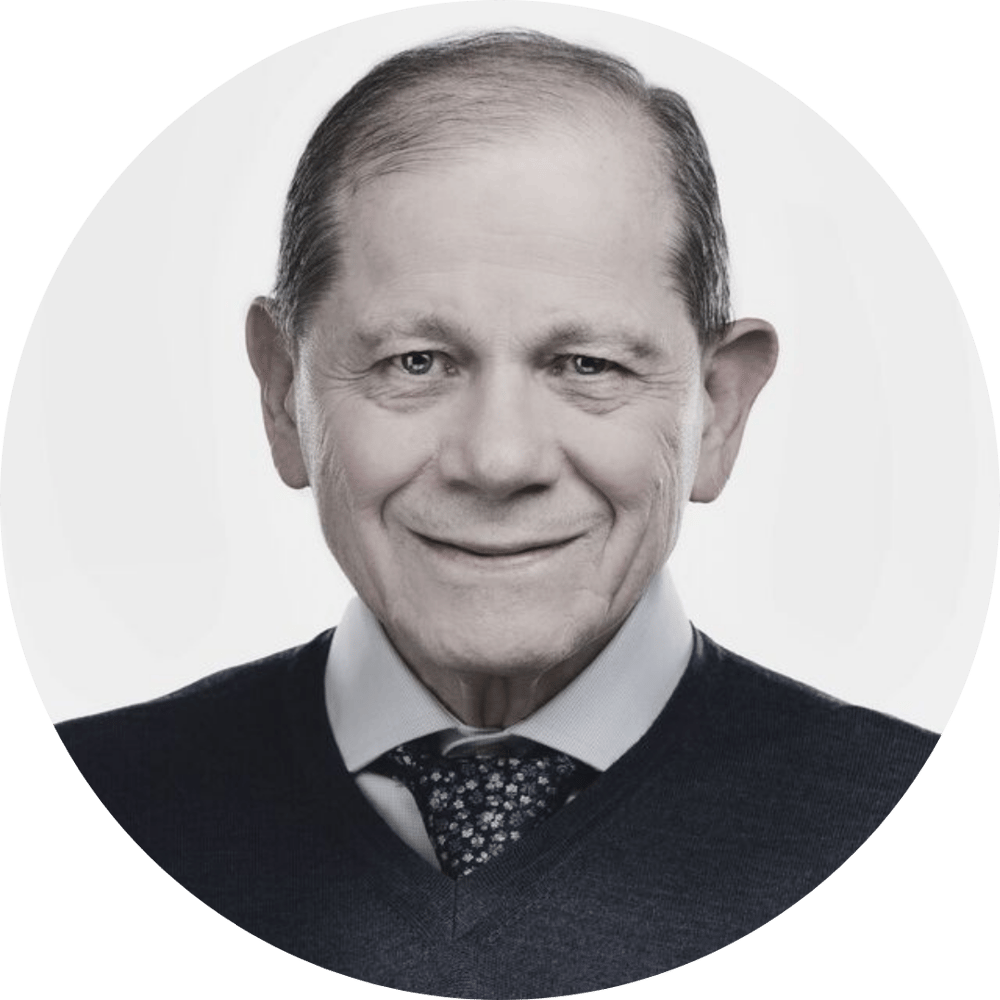
Ibo F. Meléndez
Founder and President
Studies how command is exercised when people depend on every decision. He was Chief Executive of Pascual Hermanos, with twelve thousand employees, and has spent more than two decades coaching more than two thousand executives, in more than thirty thousand coaching hours.

Sebastián Meléndez
Cofounder and CEO
Studies how the way of deciding changes when the world moves faster than organizations. He is the author of the trilogy available in our Store, created the TriCore model and has worked more than sixteen thousand hours with leaders and teams on five continents.
IFM Global works with leaders and teams from Costa Rica and the United States.
P.S. Chapter 9 of the study carries a calendar of signals: what to watch, when, and what would confirm or overturn this reading. Read beforehand, they help you decide. Read afterwards, they only help you comment.
IFM Global
IFM Global S.A. · San Rafael de Heredia, Costa Rica
IFM Strategic Systems LLC · United States
A leadership development company: professional services, published work, courses, events and content. More than 20 years.
© IFM Global. All rights reserved.
The ambient photographs on this site were generated with artificial intelligence. They do not show real people.